Monday, July 6, 2009

Awesome Condors!


The second day of our Colca Canon trip was mainly about seeing the Andean Condors. We left the hotel early. It was below freezing and everyone was bundled up. Our guide told us that the condors don't come out until the sun gets up high enough, so we stopped at some small towns along the way to burn up a little time.

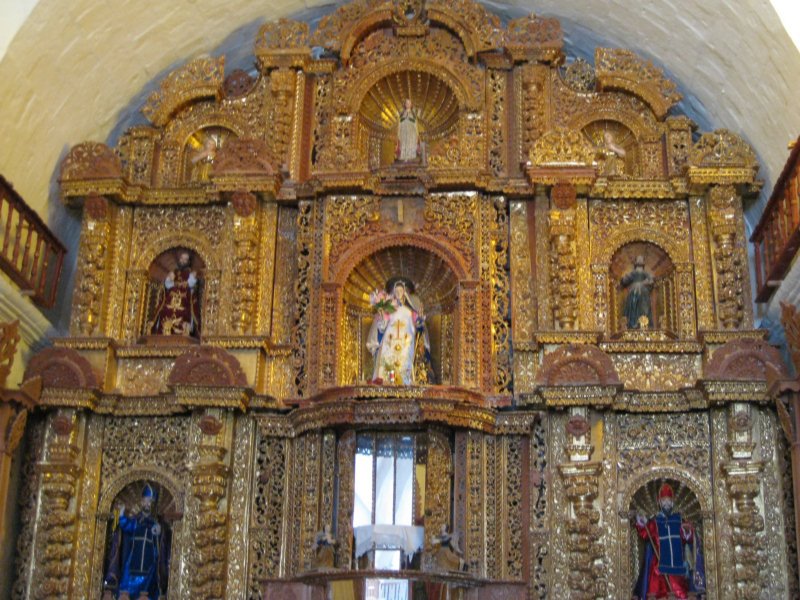
Churches Built to Withstand Earthquakes!


The towns were typical tourist stops. Each town of course has a beautiful church, a square area, ladies selling local handicrafts, and a couple of people with local animals (llamas and hawks) that the tourists pay to photograph.


One town had girls in local dress dancing around the centerpiece of the square. They do this every morning, in the freezing (but sunny) weather. Several girls had on sandals. Brrr! There are 4-5 tourist vans, and everyone taking pictures. The locals are trying to get you to buy stuff or pay for a photo. I hate this side of tourism!


The rest of the town was usually pitiful... adobe houses, very poor people trying to scratch out a living in a pretty unforgiving environment. I once again blessed my heritage.


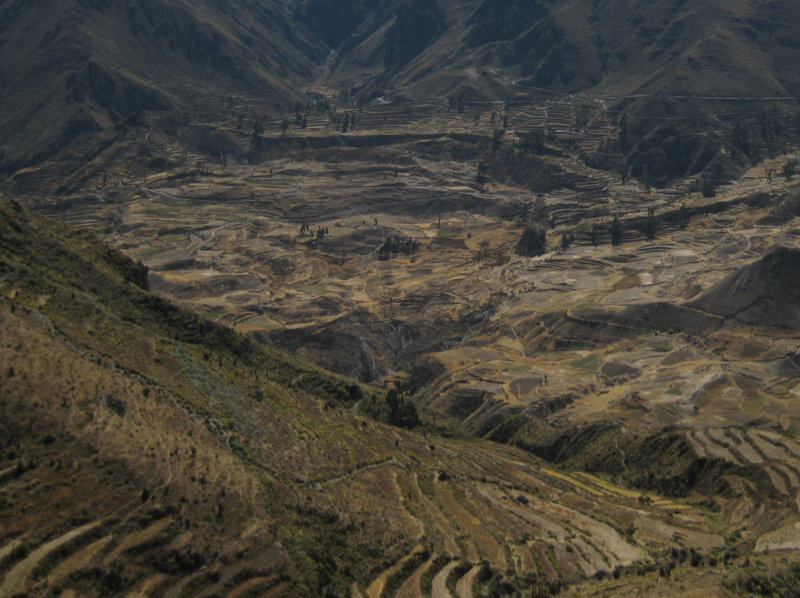
One amazing part of the landscape is the miles and miles and miles of terraced mountainside. Very little of it seemed like it was being actively cultivated now (but it IS in the middle of winter and dry season). But I assume a lot of it is still left over from the Inca empire 500 years ago.


The condor place is known as Cruz del Condor (Cross of the Condor). Just as promised, the condors were soaring... about 10 of them in all. But after a half an hour or so, they moved on down the cliff and out of sight. It doesn't look like it in the pictures, but its wingspan is 9-10 feet!!


I was feeling really bad... my bout of 'turistas' had come back unexpectedly, and the altitude was still giving me problems, and it was cold. When we got back on the bus for the trip back to Arequipa, I zonked out, even though we were on rough roads most of the way back!

Feeling Like Crap, I Bravely Smile for the Camera!

Sunday, July 5, 2009

Bus Trip to the Colca Cañon

Where we brave the dust and cold to experience vicuñas, alpacas, llamas, native dancing, hot springs, condors, and a very deep cañon.

We spent 2 days 'playing tourist' with a guided bus tour up into the Colca Cañon.

The Colca Cañon is 13,658 feet deep, more than twice as deep as the Grand Canyon in the United States. However, the cañon's walls are not as vertical as those of the Grand Canyon. The Colca Cañon is also home to the elusive Andean Condo.

This was a true tourist trip, with the old 'herd you off the bus' approach, but we only paid $22 EACH for a 2 day trip INCLUDING our overnight stay in a hotel. We saw a lot in 2 days, and had a good bi-lingual tour guide and good safe bus driver. We booked our tour with Colonia Tours, through our hotel, but others booked it through tour bookers in the square in Arequipa. We saw LOTS of other tour groups on the trip, but not all do the same trip. Though we were not offered a choice of hotel for the overnight stay in Chivay, we understand that you can chose between several hotels at various prices.


The first thing that struck us as we left Arequipa was the stark landscape... Miles and miles and miles of cold, dry scrub landscape, with a backdrop of volcanic mountains.


After a couple of hours winding higher on the typical bad Peruvian roads, we made our first stop at the Pampa Canahuas, a reserve for vicuñas, llamas, alpacas and other indigenous species. Dave got some good pics.

Wild Vicuña


Llamas and Alpacas at a Watering Hole

As we climbed higher, our guide offered us coca leaves to chew, which are supposed to help relieve altitude sickness. Altitude sickness is pretty common among travelers in mountainous Peru. We were cresting at over 15,000 feet and going to stay the night at about 12,000 feet... mild altitude sickness starts at about 8,000 feet and gets worse as you get higher. Mild symptoms are mostly wooziness, headache, and shortness of breath. Coca leaves or coca tea are common Andean solutions to altitude sickness (we were offered the same in Colombia and Chile as well). Chewing coca leaves is more effective if you also chew a little lime (calcium). Our guide thoughtfully provided both. Coca is where cocaine (and novacaine) comes from. After a few minutes of chewing the leaves, my mouth felt like I'd been to the dentist.


Though the temperature in Arequipa was pretty cool, it wasn't bad. But the higher we got on this trip, the colder it got. We saw some ice and snow. And the wind was blowing pretty good.

When we got to our hotel in Chivay, we found that though it was a pretty nice budget hotel, it had no heat at all. The tour plan included an afternoon hike to an adjoining village. Both Dave an I were feeling the cold and the altitude and opted not to go hiking. So we had a couple of hours in the afternoon to kill, in our unheated hotel room. We spent the time napping under 20lbs of blankets. (we must be getting old!).

At 6pm, we loaded up in the bus and went to the 'hot springs'. This is natural volcano-related hot springs. There were a lot of tourists there, so there was no ambiance, but at lease we were warm.

In the evening, we were treated to a group dinner and some very nice Peruvian music and dancing. (About 100 tourists packed into a restaurant).


Friday, July 3, 2009

Arequipa, Peru

We took the 'night bus' from Lima down to Arequipa yesterday. The direct trip takes about 15-16 hours, so most bus companies only offer an overnight trip. Though we missed the sightseeing, most of the route is dry desert... miles and miles of sand dunes.

We used the Cruz del Sur bus line, which has an online ticketing system, just like the airlines, you can reserve, select your seats, and pay online. We opted for the most expensive seats, what they call 'full cama' seats, which almost totally recline. So we had a much better overnight trip than we have on overnight plane flights.

Our plan was to arrive in Arequipa in the morning, drop our stuff at a hotel, and go see Arequipa (yesterday). The only problem is, somewhere in the last couple of days, we both picked up a stomach bug. So we spent yesterday hanging out in the hotel room, catching up on sleep, and staying near the bathroom.

We feel much better today, though not completely over the bug. But we're heading out to see the sights in Arequipa today, and have booked a 2-day trip into the Colca Canyon for tomorrow.


We are staying at La Casa de Los Pinguinos, about 5 blocks off the main square in Arequipa. It is run by a Dutch woman named Alex. It is a really nice place, clean and bright, great beds, hot water, great wifi, etc. Alex is very talkative and is a wealth of information about traveling in Peru. The cost is a little pricey for backpacker budgets, at $30 U.S. for a double with private bath. But they offer a really good breakfast, and Alex came to pick us up herself at the bus station. It is worth a few bucks extra here.

Tuesday, June 30, 2009

Whirlwind Tour of the Cordillera Blanca

We are almost finished with our very fast and very exciting tour of the Cordillera Blanca and Cordillera Negra mountain ranges in Peru. We have taken more than 1,000 photos in 5 days!! We will try to get some time to post a few of our best pictures in the next day or so.

Today we return to Lima, and tomorrow we are booked on an overnight bus to Arequipa, Peru (south down the coast from Lima).
-----
At 6/30/2009 1:38 AM (utc) our position was 09°31.84'S 077°31.43'W

Saturday, June 27, 2009

Cordillera Blanca - Day 2 - Huaraz to Chavin de Huantar

On day 2 our goal was to get to the ruins at Chavin de Huantar. But it took us nearly all day of exploring the small towns along the way to get there.

We stopped at the small town of Recuay, where there was a 'barbecue' going on to raise money for the church. Of course, we had to help out. Pretty small town, nice square, nice church.


We turned left at Catac, another small town and headed up into the mountains.


Our next stop was a beautiful lake. (Querococha) Here we paid 2 kids about 50 cents to hold their lambs and pose for the camera.


We also had a little 'Mate de Coca' (Coca Tea), to help rev us up for the altitude. The cutest little girl was hanging out with her mom, who was selling the coca tea.


By early afternoon we passed through the Tunel Kawish, at the crest of the mountain at 4512 meters (14,660 feet). At 14,660 feet, the oxygen is thin and we all got a little woozy. But fortunately we were headed back down the mountain.

We were amazed at the terraced farming going on all over the mountains.


When we arrived in Chavin, we found it a pretty little town. Not much there for tourists except the ruins. We stayed at Hotel Inca, right on the tiny square. The square was beautiful--filled with flowers.


The only restaurant in town that was open was called Restaurant Turistico (Tourist Restaurant). They were serving Cuy, or stewed guinea pig. It is a traditional Peruvian dish. I tried it. It was OK, but I wouldn't go out of my way to find it again.


We spent the late afternoon wandering around town. (It took all of about 15 minutes to see the whole town).

Friday, June 26, 2009

Cordillera Blanca - Day 1 - Lima to Huaraz

We set out from Lima about 10am in Edy's nice 4WD SUV, the 4 of us, plus the Darcourt's bodyguard/driver Carlos.

The first few hours we were on a good road, 4 lane, nicely paved, cruising through mostly dry desert conditions along the coast.

Huge Sand Dunes, One Part of The Incredible Peruvian Landscape

A Glimpse of the Ocean

It was about 2pm when we arrived at the turnoff in the town of Casma. We thought the next segment, from Casma to Huaraz would only take about 2-3 hours. But it turned out that that timing was based on taking the other better road. The route via Casma is an 'adventure route'. Twisty dirt road, going up and up. The GPS said it was only 53 miles, as the crow flies. But we finally arrived in Huaraz just as it got dark, about 7pm!

The hotel, Albergue Churup, turned out to be a very nice place. Great decor, great common room, good beds, hot water, good sightseeing and hiking info. We met some travelers that had been there for 2 weeks!

The Mountain Bus (and Freight) System

The Terraced Mountainside

Passing Through a Small Village

Our Hotel in Huaraz, Churup (very nice!)

Thursday, June 25, 2009

The Cordillera Blanca, Peru

We are starting tomorrow on a 5 day trip up to the Cordillera Blanca area of Peru with our Peruvian friends, Edy and Ani Darcourt.

Tuesday, June 23, 2009

Headed for Peru


Well, Soggy Paws is stripped down to the fiberglass and drying out in the nice cool dry air at Puerto Lucia.

So we are headed off to see some of Peru. We are starting in Lima, with our friends Eduardo and Anamarie. If Edy can take the time off work, we are hoping we can go together to visit the Huarez area of Peru. If now is not a good time for Edy, Dave and I will head off on our own to see Cuzco and the surrounding area.

We don't have a real concrete plan on this trip. Unlike our trip to Chile, where we almost had the entire 7 weeks planned out day-by-day. But Dave has been to Peru twice before, and we've got lots of notes from several cruising friends who've visted Peru recentl, plus the Lonely Planet. We also have the Bolivia section of the LP South America guide.. if we get a chance, we'll try to hit the high spots of Bolivia on this trip as well.

For a compact summary of where we went and where we stayed on our travels within Peru, see our Travel Peru page on the website.

Saturday, June 20, 2009

On the Hard in Puerto Lucia


Clearance in La Libertad

The clearance here was easy, but expensive. PLYC arranged for all the officials to be here. We had 5 guys in our cockpit... 4 officials and an agent. We only had to pay $13 for 'Reception', but the agent gave us a 'bill' that we will have to pay on clearing out, for the following additional costs:

Zarpe: $43.50
Immigration: $15
Agent Fee $185

This is just for clearance from Bahia de Caraquez, and our clearance back to Bahia. Coming in from somewhere else, would cost a little more, I think. We DIDN'T have to pay a 'lights and bouys' fee, which we had already paid in Bahia (and could show a receipt for).

The agent fee is for a commercial agent to do all our in/out paperwork. (In Bahia, an agent is also required when entering or leaving, but Puerto Amistad acts as the agent and charges no fee).

I am not sure who bore the cost of getting the officials here... in Bahia you pay $60 taxi fare to taxi the officials from Manta. This fee is likely either the 'Reception' fee, or embedded in the Agent Fee.

We discussed with the Customs official, the one who has been making cruisers lives miserable here, our plans to stay at Puerto Lucia for about 2 months. This is the guy who has been using a rule not intended to apply to sailing vessels, to limit the boat stay to 6 months. (which, of course, can be extended if you jump through the right hoops). He agreed that we could stay 2 months (which would make our stay 'in country' over 6 months), and said that if we needed more time, we'd just need to write a letter explaining that we were still working on the boat. We won't know how this will all turn out until we leave, but we're not too worried about it.

Haulout

Costs to Haul Out, for our 44' Boat are as follows:

Travel Lift: $445.76 (does not include pressure wash)
Monthly Fee: $663.04 / mo (gets a little cheaper months 3+)
Liveaboard fee: $5/day
Water: Metered at $3/250 gallons
Elec: Metered at .25/Kwh

The 'Liveaboard Fee' only applies when we are actually on the boat. It seems high when added on top of Water, Electricity, and the monthly cost for the boat, but what it does is give us access to the BEAUTIFUL club facilities here.

I think dockage is the same as the 'on the hard' fee. And right now there are plenty of slips available. The prices are high for Ecuador, but the facility is first class. Is a great place to leave the boat safely.

Puerto Lucia Yacht Club

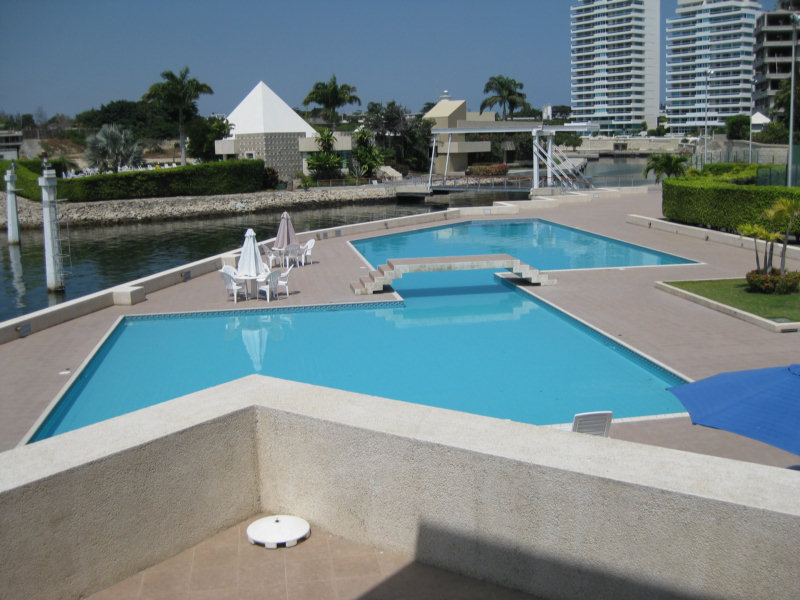
Wow, what a nice place. This is a full 'yacht club' complex, including about 10 hotel rooms, 2 restaurants, 2 pools, a sauna, 3 tennis courts, a fully-equipped gym, a computer room with internet access, a 24x7 gate guard and foot patrols. The $5/day liveaboard fee (which is NOT optional, if you are here), pays for access to all that.


There is a big mall right down the street, complete with 8-screen movie theater, food court, and a big 'Hypermart', which is somewhat like a Super Walmart... Ace Hardware, clothing store, and big grocery store in one.

We haven't yet had time to explore the town of La Libertad, but I know there is a great market there, where we can get fresh veggies and seafood for really good prices. It's a 35-cent bus ride from here, or a $1 taxi ride. And the beach town of Salinas is about the same distance in the other direction.

The Weather and Working Conditions

We have never had such a nice environment for working on the boat. Or living on the boat for that matter. The temp is a fairly constant 75F during the day, and a little cooler at night. There's usually a 10kt breeze. It is dry, no thunderstorms, or the hot muggy weather that's in Costa Rica, Panama and Colombia right now.

Stewart Yacht Services

Run by Canadian ex-pat, George Stewart, and his Ecuadorian wife, Marisol, Stewart Yacht Services is a do-all yacht services company that works out of PLYC. He comes highly recommended by other cruisers. We have George and his guys stripping Soggy Paws down to bare fiberglass, addressing blister issues, and then building it back up with a barrier coat and bottom paint.

So far we have found George very helpful and knowledgable, and his 'guys' very hard workers. We are paying George for good, experienced workers at the rate of $60/day, plus materials. George regularly ships stuff from the U.S. into Ecuador, and also knows all the local contacts for things like galvinizing chain, bottom paint, etc.

Immigration Issues

We were really sweating the 3-month tourist visa limitation, when we found we didn't get 'reset' on re-entry to Ecuador a few weeks ago. But since then, we know of one cruiser here at PLYC who successfully extended himself another 6 months (in Guayaquil). He documented the process for us, and we plan to follow his lead and do our own extension when the time comes.

Diesel Fuel

Getting diesel fuel has been a bit of a problem in Ecuador in the last few years. The problem is, they sell fuel to the people of Ecuador at nationally subsidized prices (the price is currently around $1/gallon ). Apparently some boats (maybe not cruisers, but fishing boats) were coming to Ecuador and filling up, and then going elsewhere and selling Ecuadorian fuel at a huge profit. So Ecuador made a law that prohibited selling fuel to foreigners. Of course, that was a great inconvenience for visiting sailboats, and there has been much said about the problem in the SSCA newsletters and online forums.

Now, 2 years later, things have settled out a little. Puerto Lucia has a permit, that they say cost them $100,000 in fees and surveys, to sell fuel to foreigners. The cost for 'foreign fuel' is around $2/gal right now. Double what the locals pay, but still substantially cheaper than surrounding countries.

Bahia WAS selling fuel under a temporary permit, for $1.50/gal when we arrived in Feb. But recently, they became 'unpermitted' (don't ask, we don't know). Tripp Martin at Puerto Amistad is working feverishly on formalizing an official permit. In the meantime, there is a 'workaround' so cruising boats coming to Bahia can get diesel when needed.

Ecuador is a great place, I can't believe there aren't more cruisers here. Even with the changing regulations and the high agent fee in Puerto Lucia, it's still a great place.

Friday, June 12, 2009

Bahia de Caraquez to Salinas (Puerto Lucia Yacht Club)


On exiting Bahia de Caraquez at high tide in the evening, the weather did not look very good. It was overcast and blowing about 12-15 knots on our nose. The exit was slow going out against the wind and the waves... we were only making 2 knots!

It was a little scary doing the exit... we had Carlos aboard to pilot us out, but waves breaking on either side and the depth going to 8'. We knew that once we went out, we wouldn't be able to go back in, if we thought the conditions were too bad.

Though the wind was fresh enough that we could have cracked off and sailed (t-t-t-acked!), we were on a schedule and so just put the reefed main up and motorsailed. Fortunately as we got offshore a little ways, the wind eased some, and it wasn't straight on our nose. So it wasn't too bad.

Through the night, as we navigated our way around numerous poorly lit small fishing boats, the conditions gradually got better. The afternoon winds eventually lay down and it became the nighttime calms. By our second watch, after we had rounded Cabo San Lorenzo and headed south, we were making good time, and the off watch person was able to sleep well.

The dawn revealed one of the fishing boats we'd been watching in the night... a shrimper. We'd been dodging them all night.

We also got a spectacular show from a couple of whales that were jumping out of the water. It's mating season and I think this guy was showing off.


By about 3pm, we were at our anchorage for the night, Ayanque (or Ayangue, depending on which chart you look at). 01*59.01’ S / 80*45.25’ W

It wasn't great, but probably better than anchoring along the beach in the open. When the wind was blowing, the waves were coming directly in the opening. Since our bow was to the swell it wasn't bad. But during the night, the wind quit/switched, and we ended up sideways to the entrance. But it was a gentle roll, nothing like the rockin and rollin we experienced at Cocos.

The next morning (June 11), we got going early, to get into Puerto Lucia early enough to get cleared in and get hauled out on the late afternoon high tide.