 Dave did an extensive presentation on Cruising the Western Caribbean at the Seven Seas Cruising Association 2008 Gam.
Both presentations (and some useful cruising links) can now be found on our Presentations page.
Dave did an extensive presentation on Cruising the Western Caribbean at the Seven Seas Cruising Association 2008 Gam.
Total Nights: May 25 - Aug 7 439
Nights Spent On Passage: 11
Nights Spent on Anchor: 162
Nights Spent in a Marina: 266
- 'Traveling Inland': 62
- In the U.S.: 50
We managed to sail for just 2 hours. The wind was mostly in our favor us, but too light for the wave conditions. It has been blowing pretty hard NE of here, and the swells are pretty big. So the sails flop too much as the boat rolls, with big seas and light winds.
We plan to be in Linton by Saturday or Sunday, and in Colon by Monday. Daughter Nicki flies in to Panama City on Weds.

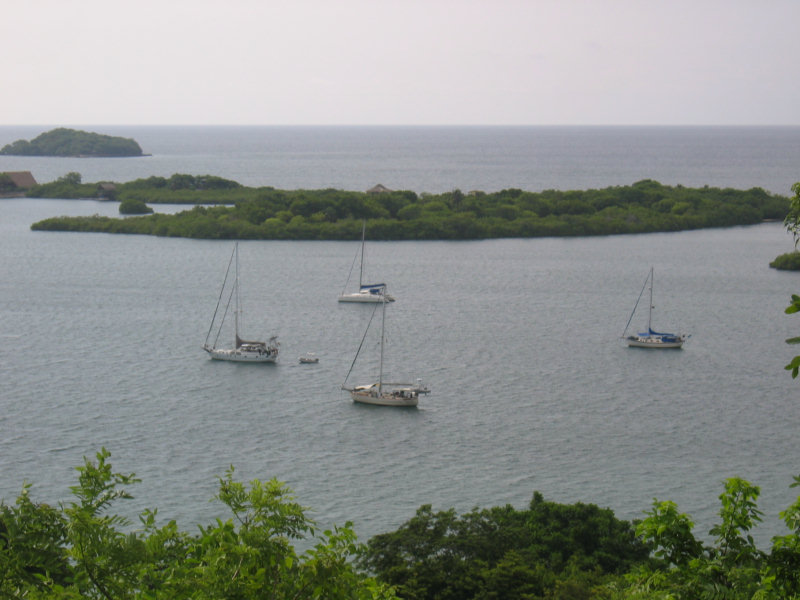 The Killer View from Crow's Nest
CBARUa 10-07.90 N 75-43.61 W South Approach 'a'
CBARUb 10-08.39 N 75-43.36 W South Approach 'b'
CBARUc 10-10.29 N 75-41.71 W South Approach 'c'
CBARU1 10-10.78 N 75-40.48 W Beginning of Markers
CBARU2 10-10.54 N 75-40.39 W
CBARU3 10-10.32 N 75-40.36 W
CBARU4 10-10.09 N 75-40.30 W
CBARU5 10-10.01 N 75-40.25 W
CBARU6 10-09.74 N 75-40.15 W
CBARU7 10-09.82 N 75-39.46 W Anchorage
We were able to sail for about 5 hours yesterday. But the wind died off in the late evening, and we ended up motoring most of the way.
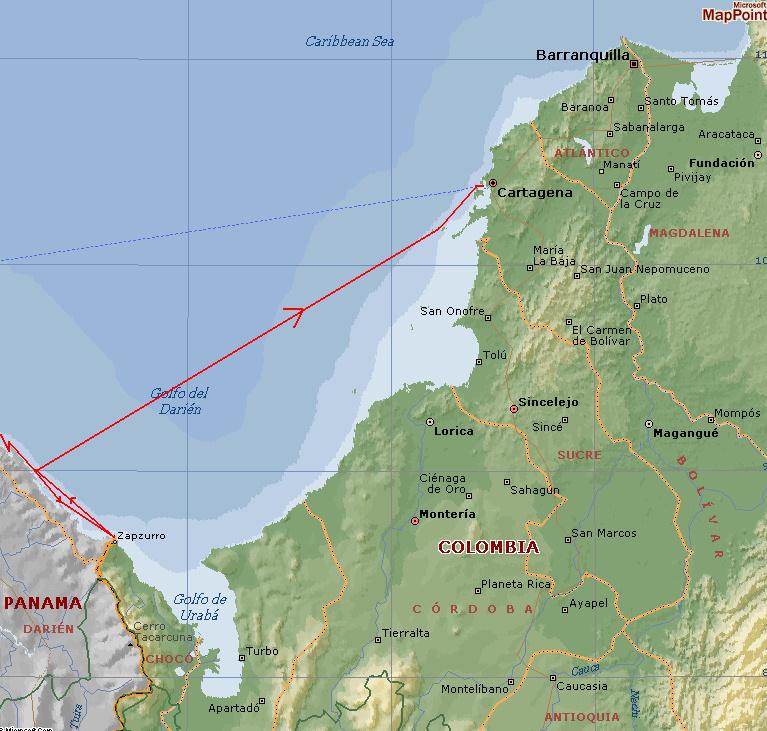
We'll stay here tomorrow, to do a bottom scrub and put the watermaker to bed, and then head for Cartagena on Friday.
Here are the waypoints we used:
CROSAR - Approach from SW
10-09.206 N 75-45.924 W
CROS01 - Beginning of shallow area
10-10.002 N 75-46.204 W
CROS02 - End of shallow area
10-10.620 N 75-46.550 W
CROS03 - Anchoring area
10-10.660 N 75-46.550 W
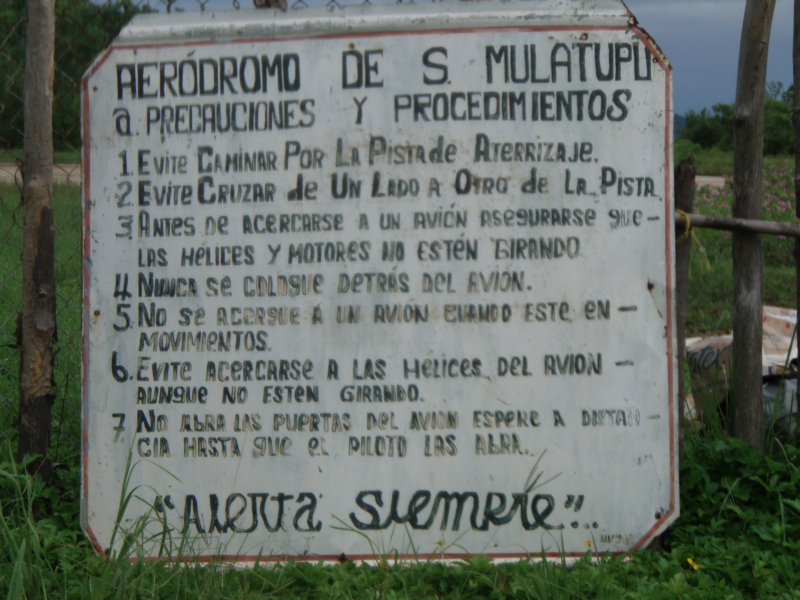
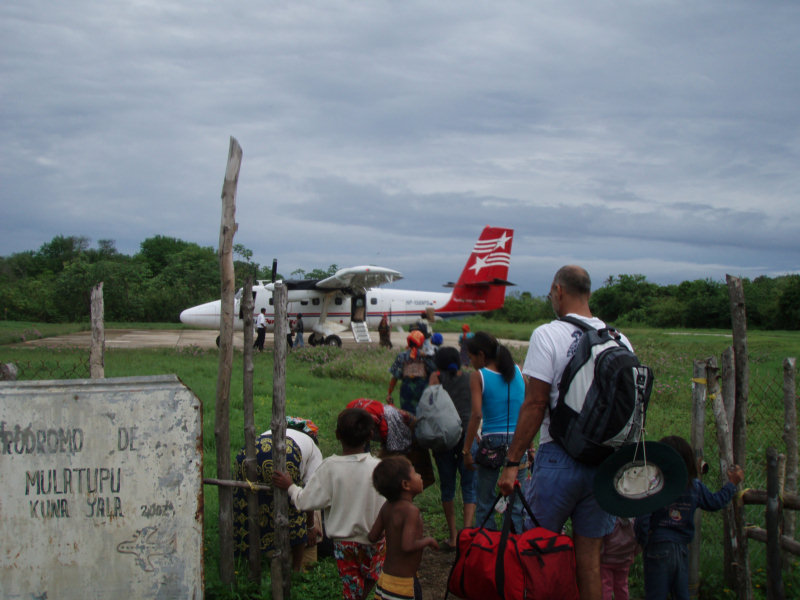
We did get about 2 hrs of internet in Sapzurro, but a big thunderstorm the night we got there took out the town's electricity and internet connection. They got the electricity going pretty quickly, but the internet never came back before we left. :(
So now, no more excuses, and starting to get low on water. Dave's first priority was to get the long-awaited water maker running.
We picked a good anchorage with few distractions, and anchored away from the crowd. But within cell phone coverage, in case he needed to call someone for parts or information. (In the 'back of the Swimming Pool' in East Holandes).
Dave told me he had 'only another 2 hours' to get the water maker running. 2 days later, we finally cranked it up. Dave spent nearly half a day, just re-reading his notes and making a checklist for commissioning the thing... to make sure we didn't make a mistake that would break something (like we did in Providencia).
When we finally fired it up, we were very glad to find that it was working just as expected. It started producing fresh water within about 5 minutes, and amazingly had no significant leaks (you wouldn't believe the number of hoses, valves, and connections that all have the potential to leak).
We had to let it run for an hour to get the preservative out of the membranes. In the last half of the hour, I started catching it in a bucket to do laundry with. But, at a flow rate of 35 gallons per hour, I ran out of buckets pretty fast.
The next day, we ran it for another hour to really make water. It is really good water and we are really pleased. Way better than the rusty crap we got from Guanaja, the cistern water we got from Bocas, and the river water we got from Portobelo.
Now we are just fine-tuning things. Dave is not quite sure what flow rate we can push it to without overtaxing the membranes (we have a few questions out via email to our water maker gurus). I am making a 'user's guide' on the computer, with startup and shutdown checklists, and pictures showing where the valves are. Once you understand the system, it's not that difficult. And Dave has all the valves labeled pretty clearly. But my memory isn't that great, and if Dave became incapacitated, I'd
need something to remind me what to do.
Our cell phones no longer get a signal out here (Movistar service), so the Iridium satellite phone was invaluable in calling Panama City and Miami for parts & information.
The problem Dave and John were working on was associated with alternators and the drive shaft. Apparently John had added a big alternator some time back, but not properly mounted it, and moved some as the engine was running. The movement caused wear on the splines of the pulley that drove the alternator but also drove the water pump that cooled the engine. He dismounted the alternator (he has a generator he can use for battery charging), but needed to examine the situation closely before he continued.
Losing his engine cooling halfway to Honduras wouldn't be a good thing at all. Dave was also worried that he might damage the crankshaft, which would be a major deal to repair.
The big obstacle was that the nut holding the whole assembly together was huge, and nobody in this end of the San Blas had a socket of the right size (1 11/16). And the nut was recessed, so several clever suggestions by Dave and others to get the nut off were useless.
John finally called Arturo, the guy who runs Marine Warehouse in Panama City, and asked him to go find a socket and send it to us out here via one of the puddle-jumper airlines that fly into Porvenir. Amazingly, the socket arrived 2 days later. John still doesn't know exactly what Arturo charged him for the service, but it was invaluable.
We loaded up both crews on Soggy Paws and took a day trip over to Porvenir (about 5 miles from the East Lemons) to pick up the socket from the airport. We needed to check in there anyway to pay our Kuna Yala cruising fee. And besides the parts, Caliente was out of rum, and we were also looking for a Cable and Wireless cell phone sim card. We found a nice Kuna-run restaurant on what used to be Smithsonian Island (2 islands west of the one with the airport) for lunch.
Within an hour after returning to his boat, John had the nut off and he and Dave took a good look at the situation. They decided that the situation wasn't too bad, and that removing the big alternator, adding a big washer as a shim, and properly torquing down the nut, would make things good enough for John to make it to Honduras/Guatemala without too much trouble. We motored for about 3 hours yesterday and John says the engine seems fine now.
Also while we were sitting there waiting for John to resolve his engine problems, Dave saw another boat in the anchorage with a Tohatsu 18HP (same basic model as our 15). He went over and talked to the guy and asked to take a look under the cover at the throttle linkage. He also got a Parts Manual on CD, to complement our service manual.
The guy also said he'd had a similar problem with his motor while it was still under warranty. After a lot of diagnosing, the cause turned out to be the wires running from the throttle to the rest of the ignition system. When the throttle was twisted, sometimes, two wires touched together, causing intermittent problems. He's going to check this out soon.
Dave still hasn't had a chance to try out the new pulsar coil for the outboard that John picked up for us in Panama City. But when he took resistance readings on the new coil, it reads the same as the old one. So he isn't hopeful that it will solve the problem.
We are still (theortically) only an hour away from firing up the watermaker for the first time. That's probably job one on OUR list, once Caliente leaves and we get a few days to sit and catch up on our own maintenance issues.
Once over the bar, the water deepened to about 30 feet from bank to bank. We just followed the river up about 5 miles and anchored on the 2nd left bend, as advised by our friends on s/v Gilana. Mike on Gilana hooked a Tarpon nearby, and Dave is hot to try hooking one too.
Gilana told us to 'watch for crocodiles'...apparently there are fresh water crocs milling about in the upper reaches of the river.
We had radio contact with Caliente on SSB this morning (who are in Colon, just over the hill from us), they arrived there yesterday and are doing some shopping and waiting for their guest to arrive.
We're not sure VHF will work between here and Colon (but haven't tried it yet). We have no internet but DO have tenuous cell phone service on our Panama Movistar GSM sim card.
We'll be here in the river until at least Friday.
ETA at the mouth of the Chagras River is about 9:30 this morning.
All is well aboard.
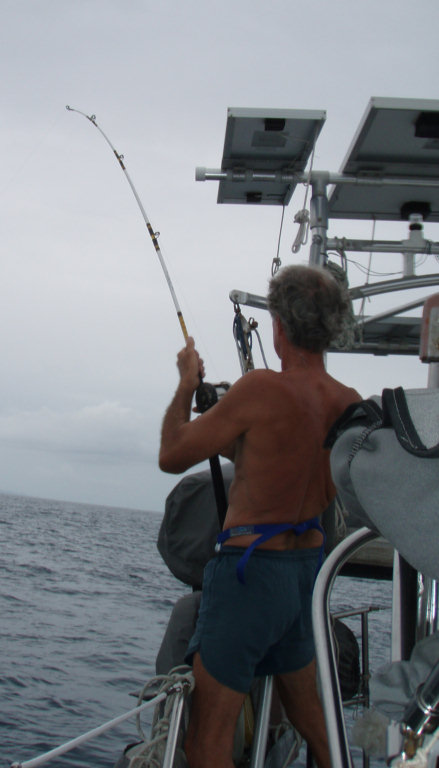 We left from Bluefields this morning and motorsailed in light southerly winds to Escudo Veragas, a small island offshore.
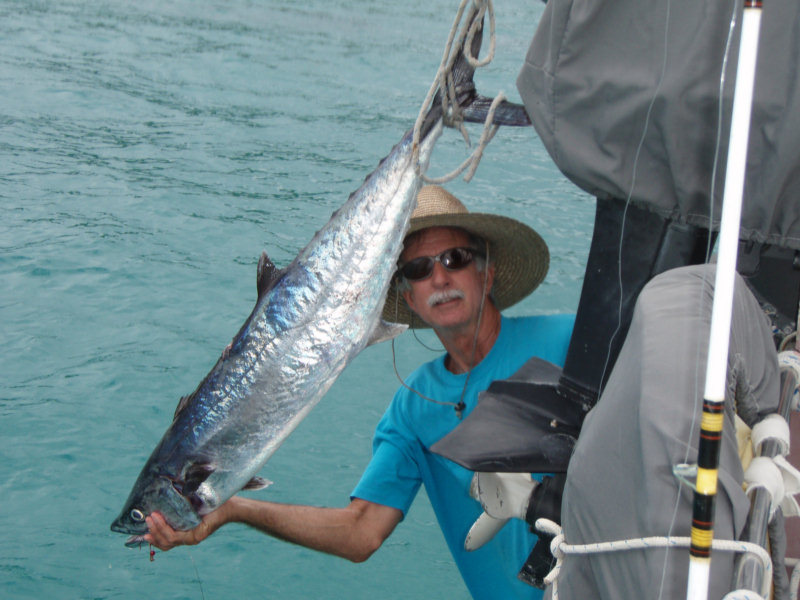
Dave caught a very small tunny as we rounded the point leaving Laguna Bluefied, and let it go. As we approached Escudo, he hooked and landed a very nice 25-pound King Mackerel. It is 44 inches long. We are having fish sandwiches for lunch!
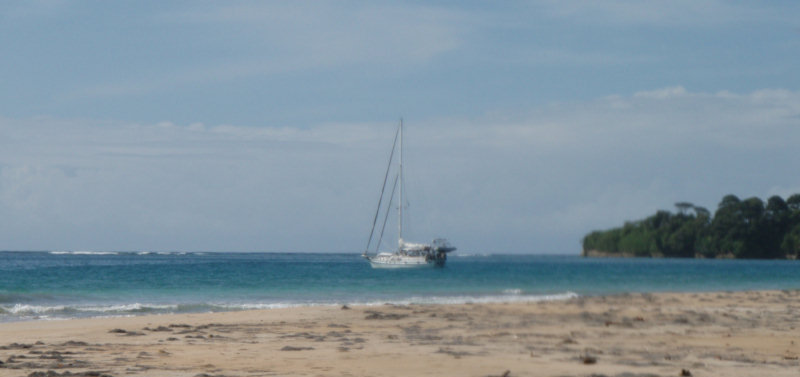
We scoped out the 2 anchorages recommended in the book, and though the current wind is a light NW, the best anchorage is on the west side of the island (open to the wind, but mostly protected from the large easterly swell). The SW anchorage suggested in the Zydler guide for westerly winds, seemed like it would be more protected, but there was a huge SE-ly swell breaking on the beach.
West Anchorage: 09-05.64N 81-34.42W
SW Anchorage: 09-05.26N 81-33.98W
Our raster chart seems pretty accurate, though there are no depth details when you get close in. Though the west anchorage spot plots just on the edge of the reef, the reef is actually about 150' north of us.
There is a nice beach ashore, with palm trees, and some fishermen's huts up the beach aways. We would like to go exploring in the dinghy, but without having someone to stay and watch the boat, we will probably just opt to swim ashore and explore a little close by.
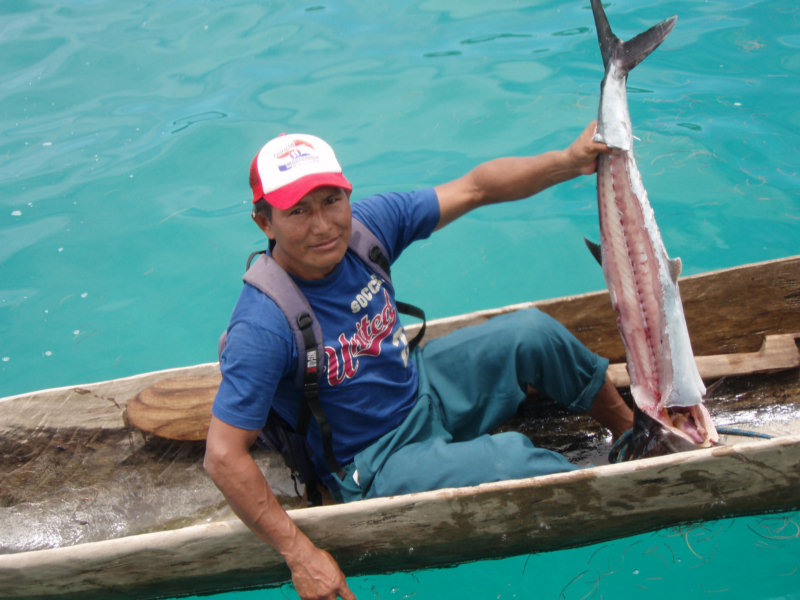
Shortly after anchoring we were visited by Mauricio, one of two gentlemen that are 'caretakers' of the island. He solicited from us a small donation to help with the upkeep of the island. (Phone service, trash cleanup, etc). We gave him the carcass of our fish, for soup, and $10.
He said that now there were about 200 people living on the island, maintaining a 'coco' plantation. (we are not sure if this is cacao (chocolate) or coconut). He nvited us ashore to visit. Dave said we'd bring some small gifts for the children we can see playing on the beach.
We took a walk on the beach and found a nice fresh water stream along the south shore. Dave really enjoyed soaking in the cool fresh water.
We will leave after dinner for a short overnight to the entrance of the Chagras River.
We entered between the Zapatillos and Isla Bastiamentos, and navigated the Crawl Cay channel without any trouble. (We used a set of waypoints given to us by Camryka).
We have anchored next to Dave's friends on Camryka in Boca Torritos. We'll stay here tomorrow and then move on to Bocas town on Monday.
We passed through 10 degrees north a little while ago and are now within 600 miles of the equator (and about 30 miles from our destination of Bocas del Toro, Panama).
Still motorsailing, though we did get to do some pure sailing most of the day yesterday. The breeze died to about 8 knots in the afternoon and we opted to turn on the engine rather than slopping around out here for days.
We still have all the sails up, and they are giving a significant speed boost, even though the wind is only about 5 knots now.
It was a lovely quiet night, light winds, calm seas, and clear skies. We had half a moon for half the night (on my watch).
It was so quiet that I brought my computer out in the cockpit and worked on a program to export my waypoints and routes from Nobeltec's Visual Navigation Suite (our chart program) to an Excel format. This makes it much easier to share waypoints with other people who do not use Nobeltec as their navigation program.
Our ETA at the outer waypoint is now about 11am, so we should be in and anchored somewhere in Bocas del Toroa a few hours after that. We have decided to go see 'Camryka Land', in an inner bay in the Bocas del Toro area. Dave's friends on s/v Camryka have built a house there, so we'll hang out there with them tomorrow and go do the official check-in with the Panamanian officials on Monday.
If we waited a couple more days for more wind, we would get squally weather with the wind, and end up motorsailing the last half of the trip anyway (the wind is always light and variable as you approach the Panama coast).
Our ETA Panama is sometime tomorrow (Saturday). We may opt to anchor up over the weekend in a bay called Bluefield and check in to Customs on Monday in Bocas del Toro.
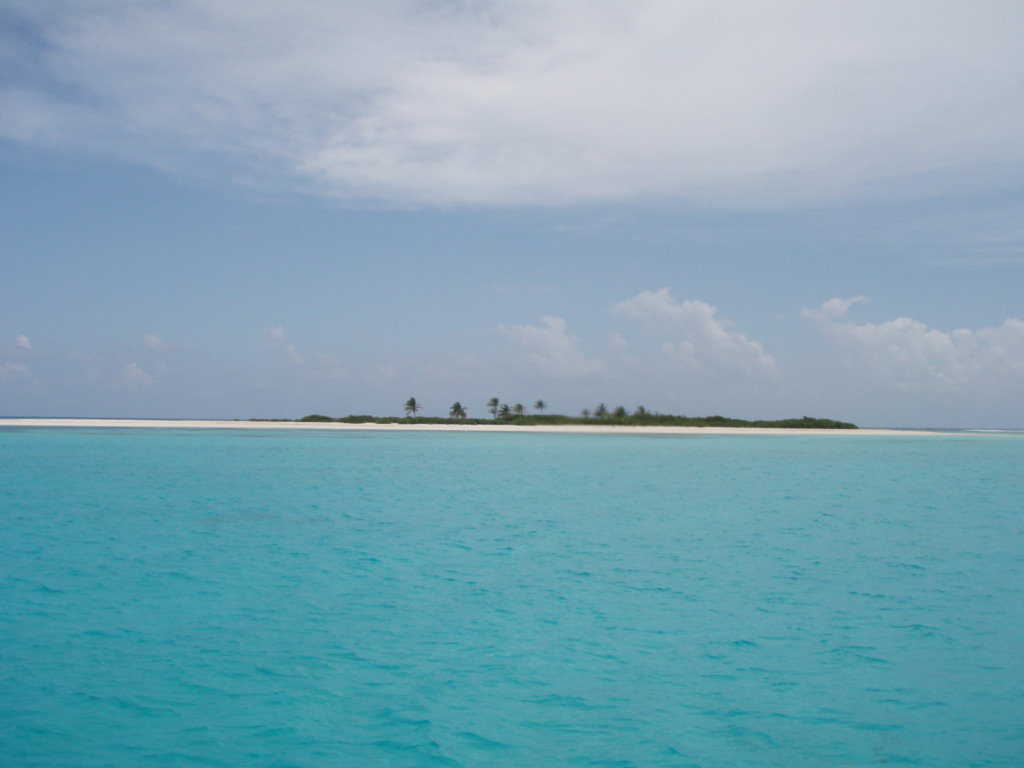
This island group, located about 15 miles ESE of San Andreas, belongs to Colombia. It has a barrier reef, 3 islands, and a sandbar with a statue on it. The barrier reef runs for about 5 miles north-south along the eastern side. Though mostly awash, the reef has several wide gaps in it that do not break.
The permanently inhabited island is Cayo Bolivar. There is a small Colombian Navy detachment there, and a light structure that sticks up high over the trees (makes it easy to identify). Nearby to the west is a clearly visible large sandbar with a white statue on it. The light was working, but on a slow blink (15 second interval according to the chart).
The other two islands are located where Cayo del Este is on the chart. They are close together with a cut between, may have originally been one island. These two islands seem to have fishermen coming and going in lanchas, and probably a fish camp there. Though remote, they are close enough to San Andreas that they may also be visited by tourist boats or weekenders.
The water here was very clear (visibility approaching 100') everywhere we went. The chart (M26081S3 - Cayos Del Este Sudeste) seems fairly accurate in features and depths, except displaced about 200 yards to the NW. Our track through a pass in the reef showed up on the chart as 200 yds SE of the pass.
We rounded the NW end of the island about 4pm at waypoint SENW and proceeded south on visual behind the reef, in the deeper water between the reef and the scattered heads to the west. The water was clear, and even at that late hour, it was pretty easy navigating around the reef areas. We looked for a good anchorage in the the extensive sand near the NE corner, but the sand was either 5 feet deep or 35 feet deep, so we kept working our way south.
There was another sailboat anchored west of Cayo Bolivar, so we decided to go down there and check it out. As we got closer to Bolivar, we got a VHF call 'Yate yate, Bolivar'. We eventually figured out they were calling US, and it was the Colombian Navy on the island. The caller spoke only Spanish and wanted to know the name of the boat, our nationality, the Zarpe number, where we were from, how many people on board, and how long we planned to stay. We were not required to physically go to the island. We told them we were going to try finding a 'mas tranquilo' anchorage to the east, and they said 'OK'.
We could see that the sailboat anchored there (a Dutch vessel named s/v Garimar) was rolling a little, so we decided to try to work up closer to the reef and behind Cayo Este.
We eventually worked our way up into about 8 feet of deep sand behind Cayo Este, with a minimum depth of about 6-7 feet getting in. See way points SE11-SE13 below, and the anchorage at SEESTE. This is definitely a 'requires good light' entry, and we did have to weave around a few coral heads. This was a relatively calm anchorage in ENE 10-15. However, it would be EXPOSED in SE winds, as the reef to the SE was pretty broken in that area. The water here was crystal clear, and the sandy bottom flat for several hundred yards in all directions. The two cute little cays ahead and off the port beam had sandy beaches and palm trees. Unfortunately, we had the dink on deck, and needed to get going, so we didn't explore the islands. There was no coral within swimming distance from the boat so we didn't snorkel either.
The next morning, we moved to an anchorage to do some snorkeling and allow an easy departure in the wee hours of the morning. We went out from our first anchorage a different way than we came in. This route was deeper than coming in the previous day, and would be a better approach to SEESTE than the first one. See waypoints SE13-SE17 below. We passed a nice anchorage in 9-10 feet sand on the way out, more protected than where we ended up. See SE15Anch.
When we reached deep water, we looped back to the east and anchored between a reef area to the north and east and a grassy area to the south in 15 feet of nice deep sand. This would be a good daytime anchorage for snorkeling, with several nice reef areas nearby and a few conch in the grassy area. It would also be a possible night approach anchorage, or early morning departure anchorage. But it was pretty rolly, with swell from the south wrapping around the south end of the barrier reef, even in light ENE wind. See SE18 and SE18Anch. It might be possible to get away from some of the roll by moving several hundred yards further east in this same anchorage.
Waypoints NOTE: GOOD LIGHT REQUIRED!!!
SENW 12 27.750 N 81 29.713 W Approach waypoint in 50', from the north
SE11 12 24.221 N 81 28.638 W 1st wpt to Cayo Este Anchorage
SE12 12 24.377 N 81 28.131 W 2nd wpt to Cayo Este (skinny water, heads, between 11 & 12)
SE14 12 24.049 N 81 27.786 W 3rd wpt to Cayo Este Anchorage
SE13 12 24.038 N 81 27.561 W 4th wpt to Cayo Este Anchorage
SEESTE 12 23.971 N 81 27.386 W Anchorage at Cayo Este
Note: An easier entry to SEESTE is below
Navigate around Cayo Bolivar to the west and start WSW of SE17
SE17 12 23.727 N 81 28.197 W 1st waypoint in 35 feet, approach from WSW
SE16 12 23.794 N 81 28.136 W 2nd waypoint in 20 feet
Between 16 & 17, coral heads, but none shallower than about 15 feet
SE15 12 23.945 N 81 27.942 W 3rd waypoint
SE15Anch 12 23.945 N 81 27.942 W Nice sandy anchorage in 10 feet
Can also proceed from SE15 to 14 & 13 to SEESTE, carry 7' in.
Easy in/out Anchorage (rolly)
SE18 12 23.679 N 81 28.023 W 1st waypoint in 35 feet
SE18Anch 12 23.713 N 81 27.938 W Anchorage (don't drift left of course in
You might do better anchoring behind Cayo Bolivar
for an easy in/out anchorage.
We don't know anyone who's been here before and couldn't find any info about them in any SSCA bulletin, website, or guidebook. But the chart looked pretty detailed, so we thought we'd give it a try. Our bailout plan was to head for San Andreas if it looked like a dangerous place.
Our course was a comfortable 185 degrees, and we had a nice 15 kt breeze from the ENE, so as soon as we cleared the SW tip of Providencia, WE TURNED OFF THE ENGINE. We sailed for 9 hours averaging 6.1 knots, without the motor on! Free miles!! We have been waiting for this sail for about 11 months (or 5 years, depending how you look at it).
Needless to say, it was a very nice day.
We trolled a line but did not catch any fish. Looks like it will be chicken for dinner tonight.
Dave did an excellent job of piloting us into a quiet anchorage in 10 feet of water, snuggled up behind Cayo de Este. It is a small island encircled with beach, and populated only with palm trees. (I'll take a picture for you). We had to weave around a bunch of reefs and coral heads, with the sun setting behind us.
The weather for the next few days is expected to be 10kts or less. So we hope to be able to spend a couple of days poking around this place, and the Albuquerques, a similar reefy area about 20 miles WSW of here. We currently plan to leave for an overnight to Bocas del Toro, Panama on Saturday.
Check in was easy using Mr. Bush's services as an agent (call Bush Agency on Ch 16). An agent is required in Colombia, and Mr. Bush arranges to bring the officials out in a launch to your boat. We paid $20 USD per person for a tourist visa for Colombia. This only needs to be paid once (a year?). The agent's fee for combined check in and check out was $50 USD, paid on departure, making the total for stopping at Providencia $90. We understand that clearance in to San Andreas, the bigger island
50 miles south of Providencia, also requires an agent and a similar fee (even though we have cleared in to Providencia).
Mr. Bush is a source of all the information and services available in Providencia... if you need it, and it's available in Providencia, he can tell you where and how to get it. About the only thing we needed was water, and Bush arranged for us to jerry-jug water from the cistern at the base of the town dock. We paid only a $5 tip to Francisco, the guy that Mr. Bush arranged to help us dispense the water.
One day, Dave and I and Stephen and Josie from s/v Elysian rented motorbikes and 'did' the island. The main road on the island is only 11 miles in circumference, so even allowing for several photo stops, a lunch stop, stops at some dive shops to ask about diving, and a hike out to the big white cross overlooking the harbor, we had arrived back in the town by about 3pm. So we decided to ride back the other way around without stopping.
That was a fun trip. My first time solo on a motorcycle. I was assigned a brand new scooter with automatic shift, and thoroughly enjoyed it. There was virtually no traffic on the road, so it was pretty trouble free. We paid about $17 per scooter for the day. No deposit, no paperwork, we just took them and paid him when we got back.
We had lunch at a place in a beach restaurant called El Divino Nino (the Divine Child), in Southwest Bay, all the way at the end of the beach. Under the palm trees, on a sandy beach, gentle breeze blowing, all we could eat seafood, and a couple of beers, for $10 pp (a single plate of whatever is considerably less). The other place that looked interesting was Rolands, on Manchineel Bay. This was a little less of a shack, and seemed interesting, but we were told by friends that Divine Child was
a 'don't miss' (and we agree).
There's a cute little airport on the island. We didn't inquire about a schedule, but I would assume there's service at least a few times a week to San Andreas, where connections can be made to other places.
In addition to the Divine Child, we ate several times at the patio restaurant that is to the right of the dinghy dock on the main waterfront road. Prices are reasonable (about $1 for a beer and $5 for a chicken meal, $6 for seafood meal).
There is a weak open wifi ('default') available in the area of the dinghy dock. Most of the cruisers sat in the shade (on the ground) on the north side of the bank building. If you have a pretty good wifi receiver on your laptop, you can also pick it up at the nearby restaurant. One of the cruisers there now is trying to get them to get a better antenna and stronger wifi, so it could be picked up in the anchorage, but for now, the only strong signal available in the anchorage is locked.
There are 2 banks with ATMs in the town, we used a Master Card and had no trouble getting money. The currency is Colombian pesos at about 1,800 to the US dollar. Most places in town will take US dollars.
There are cell phones on the island, but we opted to wait til Cartagena to buy a Colombian cell phone chip.
The grocery stores (a total of 3 within a block of the dinghy dock) were OK--typical of a small island. We heard the supply boat comes on Friday, but didn't get ashore to look for groceries til Monday, and by Monday the only fresh stuff we was older and uglier looking than our 2-week-old stuff from Guanaja. So we didn't buy much except bread, a little beer, wine and rum, and some really nice Oatmeal. Decent white wine (hard to find in Central America for a reasonable price) was about $6.50 for
a low-end Argentinian Chardonay.
There is a very good hardware store along the waterfront road about 300 yards south of the city dock, with a large assortment of stainless steel fasteners and brass pipe fittings.
We ended up not diving anywhere. Though the water looked exceptionally clear, and we had fairly good weather for diving on the back side of the island, they were asking $65-$75 USD for a 2-tank dive, but nobody had much info on where the dives were (wherever you want to go, was the answer when we asked). (And we were getting low on water and I was trying to keep Dave focused on the watermaker project).
After a day in the inner harbor (anchored very close to where we were anchored on Island Time in Nov 96 for Tropical Storm Marco), we moved out to a nice anchorage off the little beach on Catalina Island, just outside the harbor. This anchorage is nice... in 20' deep, nice sand, and cleaner water. With nothing much more to do, this was a perfect place to finish the watermaker project. (see next post...)
We did a snorkel or two around the boat. There are several nice reefs within dinghy distance. In 1996 we dinghied around to the two small islands WNW of the harbor which we found "productive". But we did not get out there this trip.
By Monday, we came to a standstill on the watermaker project, and the weather indicated that the wind was going to go lighter in the next few days. So we cleared out yesterday for an early morning departure.
Some Providencia Harbor Waypoints:
13-23.95N 81-23.62W Outer Harbor 'Safe Water' buoy, lit with flashing white light
13-23.26N 81-23.13W In the 'fairway' between Red & Green buoys
13-22.82N 81-22.66W Corner of dogleg to inner harbor (diverges from main channel, but where yachts anchor)
13-22.82N 81-22.43W Inner Anchorage in 7 feet
13-22.96N 81-22.70W Beach anchorage
If coming in at night, you could drop anchor at 13-23.85N 81-22.62W in about 15' sand.
Right now, there are 2 red buoys and a green buoy before the dogleg into the inner harbor. All the lights are working, and we actually saw them doing maintenance on the buoys while we were there.